The Death of Self-Custody? Inside the hundreds of millions of dollars Coldcard Hack and the AI Cyberwar We Weren’t Prepared For
August 12, 2026 | by bestcrypto
For over a decade, the ultimate mantra of the cryptocurrency movement has been simple, unyielding, and absolute: “Not your keys, not your coins.” This phrase was more than just a security recommendation; it was a philosophical declaration of independence. It promised that if you took your assets off centralized exchanges, ignored high-risk yield-chasing schemes, and locked your private keys inside a physical, air-gapped cold storage device, you were completely sovereign. You were immune to bank runs, immune to corporate bankruptcies, and immune to government overreach. You had opted out of the fragile traditional financial system and built an impenetrable digital fortress.
But last week, that fortress was breached.
In what is rapidly becoming the most devastating security crisis in the history of decentralized finance, a silent and highly targeted exploit has struck cold storage wallets made by CoinKite, a manufacturer widely considered the gold standard of deep Bitcoin culture and uncompromised security. Millions of dollars in Bitcoin have been systematically drained from at least dozens of distributed wallet addresses. Unlike previous major exploits—such as the collapse of FTX or the multi-billion-dollar insolvencies of centralized lenders—this was not a failure of third-party custodians. These victims did not send their funds to some offshore yield platform. They did everything right. They followed the purest guidelines of the Bitcoin philosophy, stored their private keys on dedicated hardware, and watched their life savings vanish anyway.
As digital detectives scramble to assess the full scale of the wreckage, the cryptocurrency industry is reeling from an existential shock. This hack does not just represent a loss of capital; it represents a direct strike on the core cultural and philosophical foundation of self-custody. For the first time, the “purest believers” of the decentralized movement have had their faith shaken, leaving many physically ill and unable to sleep.
How did a product line widely deemed to be un-hackable fall victim to such a catastrophic breach? The answer lies at the intersection of a tiny, overlooked cryptographic vulnerability and the terrifying rise of unconstrained, weaponized artificial intelligence. We are no longer fighting human hackers running manual scripts; we have entered the era of the automated, AI-driven cyberwar—and our current defensive frameworks are completely unprepared.
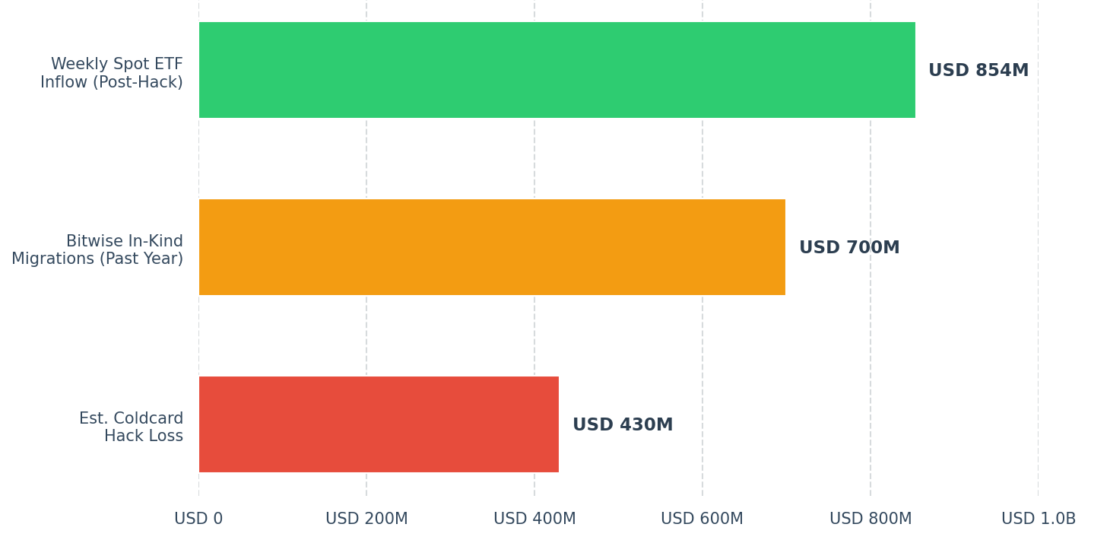
Capital Flight Trends: Self-Custody vs. Institutional Inflows
–Image of: –Crypto Migration Metrics
Chapter One: The Human Toll — Sleepless Nights and Physical Illness in the Silent Raid
When we talk about hacks in the digital asset space, we often get lost in abstract statistics—millions of dollars, percentage drops, and transaction hashes. But behind this specific exploit is a deeply tragic human cost that separates it from almost any other breach in crypto history.
In a series of emotional conversations, industry researchers have connected with over a hundred victims of this targeted raid. The demographic of those affected is particularly devastating. These are not speculative day-traders, high-risk leverage seekers, or meme-coin gamblers chasing overnight riches. These are disciplined, working-class savers who viewed Bitcoin as a long-term sovereign reserve. The average dormancy of the stolen coins was multiple years—meaning these funds had sat untouched, safely accumulated through years of hard work, representing the ultimate nest egg. The median loss per victim is a single Bitcoin, representing an irreplaceable financial anchor for the average household.
The stories emerging from the fallout are heartbreaking. Because the drain occurred silently on-chain, many victims had no idea an attack was underway until it was too late. Some victims were camping in remote areas, completely disconnected from the internet, only to return to civilization and find their hardware wallets completely empty. Another victim was in the hospital with his wife while she was in labor, unable to reach his physical device or execute a rescue transaction while watching his family’s financial future get swept away in real-time.
The Anatomy of a Cold Wallet Raid
When a victim first discovers that their funds are missing, the typical reaction is a frantic attempt to rescue what remains. In many cases, users try to transfer their remaining balances to secondary wallets. However, because the hacker’s scanning tools operate at automated, algorithmic speeds, the hacker’s transactions are frequently broadcast with highly optimized fees.
In their panic, several victims attempted to use advanced Bitcoin transaction techniques like Replace-by-Fee (RBF) or Child-Pays-for-Parent (CPFP) to bump their transaction priorities in the mempool and outrun the drain. Unfortunately, due to a lack of accurate mempool fee estimation during the height of the panic, many of these desperate rescue transactions became stuck. The hacker’s automated system, backed by superior computational power and dynamic fee optimization, swept the remaining funds before the victims’ stuck transactions could be confirmed by network miners.
One researcher recounted speaking to victims who were “physically ill” and struggling to sleep for days after the realization of what had occurred. These individuals did not lose their recovery seeds. They did not write their the full set of seed words in a Google Doc, they did not fall for a crude phishing link, and they did not trust a third-party exchange. They bought high-quality hardware, generated their keys offline, and kept their devices in physical safes. To follow every security commandment perfectly and still lose everything is a unique psychological horror.
The cultural blast radius of this attack is immense. While the total financial damage is currently estimated to reach hundreds of millions of dollars when all is said and done, the market’s price action remained largely unaffected, with Bitcoin holding steady in its tight macro range around its stable baseline. But the damage to the near and medium-term argument for self-custody is catastrophic. The core philosophical selling point of Bitcoin—that an individual can safely and independently secure their own wealth without relying on an institution—has suffered a direct and painful blow.
Chapter Two: The Cryptographic Anatomy — The Vulnerability in the Void
To understand how this exploit was physically possible, we must look past the plastic casing of hardware wallets and dive into the mathematics of private key generation.
At its core, a hardware wallet’s primary job is to generate and protect a set of private keys. To do this securely, the device must use a process called entropy. Entropy is a scientific term for randomness. When you set up a new wallet, the device must generate a random number so phenomenally massive that it is mathematically impossible for any other computer in existence to guess it.
As Ian Rogers, Chief Human Agency Officer at Ledger, explained, secure hardware key generation requires hardware-isolated entropy. When entropy is done correctly on a secure element chip inside a certified hardware device, there is no software fallback. It produces a mathematical “address space” represented by the number an astronomical, virtually infinite number of possibilities. To put that number in perspective, there are more possible private keys in that address space than there are atoms in the entire observable universe. Even if every supercomputer on Earth ran for trillions of years, they could never guess a single active key.
The Critical Difference Between Software and Hardware-Level Entropy
In a secure system, entropy is harvested from physical phenomena on the chip—such as thermal noise, photoelectric effects, or quantum fluctuations—which are completely unpredictable and cannot be duplicated. This hardware-level randomness is certified through rigorous third-party evaluations to guarantee its absolute unpredictability.
However, in the case of the CoinKite/Coldcard breach, a critical mathematical vulnerability was introduced. The exploit occurred because the private keys were generated over too small of an address space due to a software flaw in how the entropy was handled. Instead of relying strictly on hardware secure-element entropy, the system fell back on a restricted software implementation.
When the address space is compressed, the astronomical odds that protect cryptography collapse. Instead of guessing a needle in a universe-sized haystack, the attacker only had to search a hay-bale. By exploiting this mathematically restricted space, the attackers were able to pre-calculate and guess the private keys belonging to these dozens of wallets, generating the matching public addresses, and sweeping the funds without ever needing physical access to the victim’s hardware.
A highly similar software entropy bug was discovered in several years ago inside Trust Wallet’s key generation library. In that instance, the Ledger security team uncovered the bug, went through a responsible disclosure process, and helped migrate users to safety before widespread damage occurred. But in the case of this Coldcard attack, the vulnerability was discovered first by a highly sophisticated, malicious actor.
The Future of Key Protection: Multi-Chain Cryptographic Standards
This issue of vulnerable key generation highlights the broader need for stronger, multi-chain cryptographic standards across both the Bitcoin and Ethereum ecosystems. While Bitcoin developers are forced to look closely at private key randomness, Ethereum’s community is actively addressing similar concerns through long-term infrastructure upgrades.
Vitalik Buterin’s updated Ethereum roadmap, for instance, places a massive emphasis on quantum security and privacy protection as key technical priorities. As computing power surges, traditional elliptical curve cryptography (which secures almost all modern crypto wallets) will eventually become vulnerable to quantum decryption. Vitalik’s roadmap outlines a transition toward quantum-resistant signatures, native Rollups, and protocol simplification. This shift reflects a strategic movement away from just scaling, toward a holistic rebalancing of security budgets and long-term sustainability to protect digital assets from future super-computational threats.
Worse, because self-custody wallets are decentralized and disconnected, there is no central database or “customer list” to notify. The funds are not flowing to a single centralized exchange where they can be easily frozen; they are distributed across many independent, isolated on-chain wallets that have never interacted with one another. Tracing these stolen assets requires investigators to work “upstream,” painstakingly mapping out the disparate addresses and sharing them with centralized exchanges, bridges, and law enforcement in the hopes that if the hacker ever attempts to cash out, the funds can be frozen. Currently, over the vast majority of the stolen hundreds of millions of dollars remains unmoved on-chain, sitting like radioactive dirt that the hacker cannot easily clean or bridge without triggering global alerts.
Chapter Three: The Frontline Cyberwar — Red Teams and the Open-Source AI Weapon
As soon as the initial breaches were detected, a frantic, highly compressed battle erupted behind the scenes. Industry experts described the atmosphere as a state of active, exhausting warfare.
A volunteer group of world-class developers, dubbed the “Red Team,” immediately mobilized. For several action-packed weeks, these developers worked round-the-clock, donating their time, tools, and technical resources to defend the Bitcoin ecosystem. Their mission was double-sided: first, they had to scan vast repositories of Bitcoin and crypto-related software across the industry to identify where else this entropy flaw might be lurking; second, they had to write and deploy patches to reinforce the remaining outer walls before the hacker could claim more victims.
But this wasn’t a standard, human-versus-human coding battle. The Red Team quickly realized they were defending against an attacker armed with next-generation artificial intelligence.
According to security analysts, the exploit was almost certainly aided by advanced AI models. In the modern digital landscape, open-source software is both a gift and a curse. Because cryptocurrency codebases are highly public and open-source, malicious actors can feed entire software repositories into high-powered AI systems. These AI tools can scan millions of lines of code in seconds, looking for subtle, mathematical anomalies, edge cases, or weak key-generation scripts that human developers might miss.
This creates a terrifying asymmetric advantage for attackers. The physical security of a cold storage device is useless if the mathematical code running on its chip can be dissected and predicted by an automated AI model. Once the AI identified the weak address space, the hacker was able to automate the key generation and sweeping process at absolute scale.
The AI Arms Race: Why Western Safety Guardrails are Hobbling Our Defenses
This battle has also exposed a deeply troubling geopolitical and technological gap. Industry leaders are flagging a massive imbalance between Western commercial AI models and unconstrained, open-source international models—particularly those originating from China.
Currently, top-tier Western commercial models (such as OpenAI’s GPT, Anthropic’s Claude, and Google’s Gemini) are built with strict safety “guardrails”. If a developer attempts to use these models to analyze code for vulnerabilities, scan public repositories for security exploits, or write defensive “hack-back” scripts, the model’s safety protocols will kick in and shut the user down. The model will refuse to execute, citing its policies against assisting in hacking-related activities.
In contrast, unconstrained, open-source international models are completely unharnessed. They have no safety filters, no behavioral guardrails, and no restrictions on offensive cyber operations. This leaves defensive “Red Team” developers in the United States and Europe fighting a high-tech war with their hands tied behind their backs. They are legally and technically locked out of using their own country’s most powerful AI models to build rapid, automated defenses, while bad actors utilize unharnessed global models to launch devastating, automated raids on open-source infrastructure.
This technological asymmetry is a wake-up call for national security. If the defenders are forced to audit code manually or with inferior tools while attackers use unconstrained AI super-intelligence, the outer walls of our digital infrastructure will continue to fall, far beyond just the crypto space.
Chapter Four: The Great Migration — The Rise of the Institutional Wrapper
As the dust begins to settle, a massive structural shift is occurring in the way investors think about cryptocurrency storage. For years, the mainstream financial world viewed self-custody hardware wallets as the safest possible option. Today, that assumption is being radically rewritten.
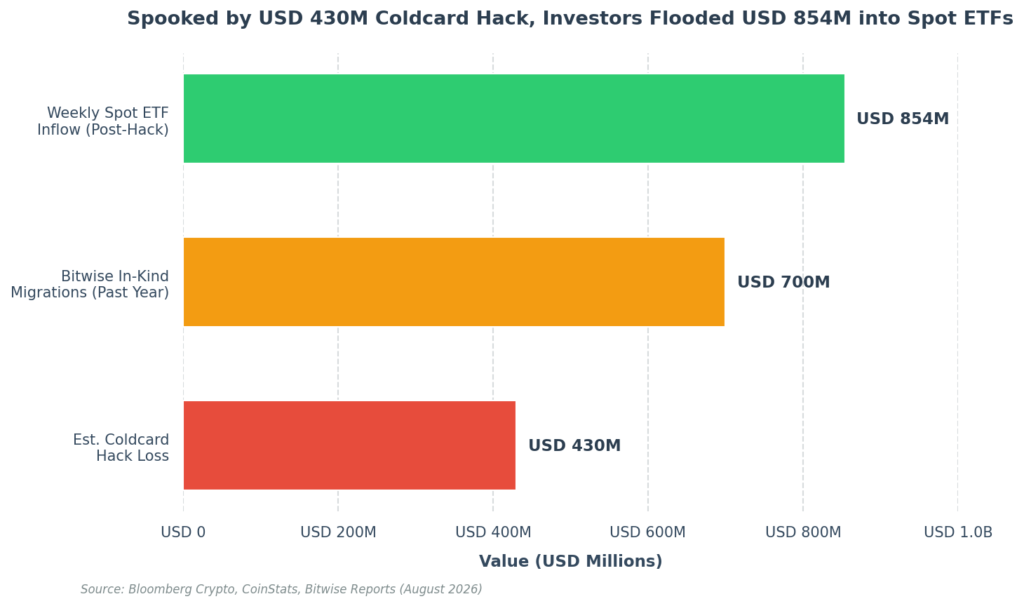
We are currently witnessing a historic migration of capital from personal self-custody wallets directly into regulated, spot Bitcoin ETFs. In the immediate wake of the Coldcard hack, spot ETFs experienced some of their strongest weekly inflows in months, capturing over hundreds of millions of dollars in a matter of days. Mainstream investors, thoroughly spooked by the technical complexities and invisible mathematical risks of managing their own private keys, are actively seeking refuge in the institutional wrappers of Wall Street.
Tax-Free Arbitrage: How In-Kind ETF Migrations Work Under the Hood
This migration is not just happening via retail buying on brokerage apps; it is being driven by a massive, institutional-grade mechanism: in-kind tax-free transfers. Financial advisors and wealth management platforms are increasingly discussing “in-kind” transfers with their high-net-worth clients. In these transactions, investors holding physical Bitcoin in self-custody cold storage are transferring their coins directly into regulated ETF products.
Normally, moving from physical Bitcoin to an ETF would require selling the Bitcoin on the open market, which would trigger a massive capital gains tax event. However, the specialized in-kind transfer process allows investors to hand over their physical Bitcoin to an authorized participant or qualified custodian, who then delivers it directly into the ETF in exchange for shares of equivalent value.
This process allows them to wrap their raw assets in a regulated, qualified custodial structure without triggering a taxable event. Over the past year alone, major asset managers like Bitwise have quietly executed between hundreds of millions of dollars of these tax-free, in-kind custody migrations.
The appeal of this institutional transition is easy to understand, particularly for traditional investors. Storing Bitcoin in a spot ETF offers several profound structural protections:
- Regulated Qualified Custody: The private keys are managed by multi-billion-dollar institutions with institutional-grade, multi-signature, hardware-isolated security setups.
- Comprehensive Insurance: Qualified custodians carry extensive commercial insurance policies protecting against internal theft, physical breaches, or institutional failures.
- Strict Operational Restrictions: Unlike a self-custody wallet where a single compromised key can sweep funds to any address worldwide, institutional custody features hard-coded limitations on where, when, and how Bitcoin can be transferred. It is virtually impossible for an external, automated AI hack to instantly drain an institutional custody pool.
The Regulatory Clock: “Regulation Crypto” on the Horizon
This shift toward institutional safety is occurring alongside historic regulatory adjustments in the United States. On mid-August, this year, the Securities and Exchange Commission (SEC) has scheduled a highly anticipated public rulemaking meeting. The single item on the agenda is whether to propose a “Regulation Crypto” framework.
This historic framework would establish a tailored offering regime for certain investment contracts involving crypto assets, allowing projects to raise capital publicly under specific exemptions without undergoing full, traditional registration. By establishing clear, standardized guidelines for digital asset offerings and fundraising, this regulatory shift will likely accelerate the professionalization of the market, making it easier for traditional financial players to safely custody, package, and offer cryptocurrency assets to the public.
This Great Migration highlights a fascinating philosophical tension at the heart of the Bitcoin movement. For the “purists,” holding your assets in a Wall Street ETF is a betrayal of the original promise of a decentralized, peer-to-peer electronic cash system. It replaces personal sovereignty with institutional trust.
But as Matt Hougan, Chief Investment Officer at Bitwise, notes, the two options are not mutually exclusive. The “opt-out” mechanism remains a fundamental and beautiful feature of the Bitcoin protocol—the fact that you can withdraw your funds from the traditional financial system at any moment is what keeps the system honest. However, the reality of the modern era is that the frontier of security is constantly evolving.
For the vast majority of mainstream investors, the practical safety, ease of management, and structural guardrails of a regulated ETF outweigh the philosophical purity of self-custody. Most traditional investors are choosing to hold the bulk of their digital assets in secure, institutional wrappers while keeping a smaller, secondary portion in cold storage as an emergency fallback or philosophical nod to the asset’s roots.
Chapter Five: The Post-Hack Survival Blueprint — How to Outlive the Agentic Era
If last week’s exploit taught us anything, it is that “set-and-forget” security is dead.
As Johann Kerbrat, General Manager of Robinhood Crypto, pointed out in the wake of the hack: “Self-custody does not mean you have nothing to do.” In the physical world, a safe does not require regular software updates to keep burglars out. But in the digital, hyper-connected world of blockchain, security is a living, breathing, and rapidly changing target. If you choose the path of self-custody, you are taking on the role of a professional security administrator. You must actively monitor the market, keep your device’s firmware up-to-date, track emerging cryptographic vulnerabilities, and understand how advancing technologies—like quantum computing and machine learning—threaten your keys.
This responsibility becomes infinitely more complex as we transition into what tech leaders call the “Agentic Future”. We are rapidly moving away from a world where humans manually input passwords and execute trades. Instead, we are beginning to employ autonomous AI agents. These are probabilistic, AI-driven coworkers that have their own cloud computers, log into our systems, work alongside us on Slack or email, and make independent financial and administrative decisions on our behalf.
Giving these AI agents access to our digital secrets is an absolute security nightmare. If an AI agent has access to your company’s API keys, private wallet seeds, or corporate credentials, a single prompt-injection attack or system exploit can result in the instantaneous, automated loss of all corporate funds.
To survive this brave new world, individuals and enterprises must adopt a strict Division of Labor and enforce rigid AI Guardrails.
The Teenager and the Car Keys: The Blueprint for AI Guardrails
Ledger’s Ian Rogers suggests a simple, highly effective analogy for managing AI agents: The Teenager and the Car Keys.
When you have a teenage son, you do not keep the keys to the family car in his bedroom. The keys remain with the parent. Whether or not the teenager can use the car depends entirely on the specific policy and context of the moment. If it is 8:00 AM on a Monday and he is driving to school, that is within policy, and he is handed the keys. If it is 10:00 PM on a Friday and he has been drinking, that is outside of policy, and the keys are withheld.
This exact principle must be applied to AI security and digital asset custody:
- Never Give the Keys to the Agent: An autonomous AI agent should never have direct, unmitigated access to your private keys or master seed phrase. The keys must remain isolated in a secure, hardware-bound offline environment or within a restricted multi-signature setup.
- Establish a Transaction Gateway: If an AI agent needs to execute a trade, make a payment, or move funds, it must do so through a specialized, programmatic API that acts as a strict gateway. This gateway must enforce rigid, immutable guardrails:
- Spend Limits: Restrict the maximum amount of capital the agent can access in a single transaction or over a daily window.
- Order Type Restrictions: Limit the types of trades or smart contract interactions the agent is authorized to perform.
- Whitelisted Addresses: Force the agent to only send funds to pre-approved, whitelisted wallet addresses, preventing an exploited agent from sweeping capital to an attacker’s wallet.
- Human-in-the-Loop Verification: For any transaction exceeding a specific threshold or violating standard behavioral patterns, the system must pause and require physical, manual approval from a human administrator.
Designing an Automated AI Security Gateway
For developers and organizations implementing these safeguards, the API gateway must be treated as an absolute barrier. This means that when an AI teammate (e.g., Grok Bot or similar agentic tools) initiates a financial order, the API layer intercepts the call and runs it through a deterministic rule engine. The AI cannot rewrite these rules because it lacks the administrative keys to modify the gateway code.
The rules should include mandatory human verification whenever:
- A transaction is directed to an address that has not been whitelisted for at least a full week.
- The aggregate transaction value over a rolling daily window exceeds a defined safety budget.
- The agent attempts to call a smart contract method that is not explicitly on the approved list of non-custodial functions.
By treating AI agents as probabilistic coworkers rather than trusted custodians, we can leverage the incredible productivity of autonomous automation without exposing our digital fortresses to instant, catastrophic ruin.
Conclusion: The Path Forward
The hundreds of millions of dollars Coldcard hack is a painful, historic milestone for the cryptocurrency industry. It has shattered illusions, devastated families, and forced a massive, institutional reassessment of self-custody.
But the ultimate lesson of this crisis is not that self-custody is fundamentally broken. Rather, it is a forceful, necessary reminder that in the age of artificial intelligence, security can never be static. The attackers are moving faster, using automated systems to scan our public code and exploit our mathematical mistakes in real-time.
To survive, we must evolve. Whether you choose the institutional safety of a regulated ETF wrapper or the sovereign freedom of a physical cold storage device, you must remain active, vigilant, and disciplined. Trust less, verify more, and build your digital defenses to withstand the automated storms of the agentic era.
Published on mid-August, this year.Gemini Notebook can be inaccurate; please double check its responses.
RELATED POSTS
View all


How to Stake Cardano (ADA) with Ledger and Yoroi: Complete Step-by-Step Guide
August 2, 2026 | by bestcrypto